 Image via Wikipedia
Let's face it, an awful lot of nonsense is written about attachment. I shall save my concerns about the misuse of attachment ideas (particularly by the parenting industry) for another day, but for now I'm delighted to catch up with a study by Susan C. Johnson and colleagues, which demonstrates some rare right-minded thinking about this most important of topics.
The study, published in the journal
Psychological Science, tackles a question that is close to my heart: the formation of internal working models (IWMs). According to the pioneering British psychiatrist
John Bowlby, IWMs are psychological representations of how the social world functions, which work together with the instinctual attachment system to set the tone for the child's future social relationships. Nowadays psychologists use four attachment categories to describe the different attachment behaviours shown by infants: secure, insecure-avoidant, insecure-resistant and disorganised. Broadly speaking, each of these attachment categories is thought to be the product of a different type of IWM.
Until quite recently, IWMs had an odd, semi-mythical status in developmental psychology. Everybody accepted that they were important, but no one had caught sight of them. They show evidence of their works in behaviour (in infants' responses to separation and reunion in
the Strange Situation, for example), and in representations of attachment relationships later in life. But their status as social-cognitive entities, about which we can do proper science, was uncertain.
The point of IWMs is that they give infants a blueprint for predicting what people will do in certain situations. I'm going to speak generally, partly for simplicity and partly because the study I want to mention did not distinguish among the three different insecure categories. Secure infants have expectations that caregivers will respond to emotional distress, while insecure infants' IWMs will not predict the same degree of responsivity. (In our own research, we are busy trying to pin down the precise differences and similarities between insecure-avoidant, insecure-resistant and disorganised infants' IWMs, but more of that another time.)
Johnson and colleagues wanted to know whether IWMs could be seen in action in contexts other than the Strange Situation. They used a
habituation paradigm to measure babies' responses to different attachment-related events. Babies saw a couple of animated blobs, one large (the 'mother') and one small (the 'infant'), appearing together and then being separated by the mother blob moving away. The infant blob then made a human infant cry and started pulsating and bouncing. The question was how the experimental participants would react to the virtual infant's distress. Specifically, the researchers wanted to know whether the babies would be more interested in a 'responsive' outcome, where the mother returned to the infant, or an 'unresponsive' outcome, where the mother continued to move away from the infant.
The results supported Johnson et al.'s predictions. Secure-group babies looked longer at the unresponsive outcome compared to the responsive one, while no such difference was seen in the insecure group. In the context of research with babies, longer looking times are generally taken to be a sign of interest or surprise on the baby's part. The secure babies seemed to have a model of how the social world worked, to which the unresponsive event was a bad fit. Their blueprints for social interaction predicted that a mother would return to a distressed infant, and so they showed interest when that event did not happen.
We have much more to learn about the psychological models that underlie attachment behaviour. The Johnson et al. study is a valuable attempt to apply the methods of infancy research in tracking those models back to the earliest days of the attachment relationship. When talking about attachment, it is best to stick to the facts—and here are some welcome new ones.
 Image by BreckenPool via Flickr
![Reblog this post [with Zemanta]](http://img.zemanta.com/reblog_e.png?x-id=6123e252-1765-4225-b270-bdbf7c0c38fc)
![Reblog this post [with Zemanta]](http://img.zemanta.com/reblog_e.png?x-id=74ba71c4-63eb-40fd-b208-8e793cd18789)
![Reblog this post [with Zemanta]](http://img.zemanta.com/reblog_e.png?x-id=a8838148-2bd6-458d-9a50-d3e1c7144f6d)
 Image via Wikipedia
![Reblog this post [with Zemanta]](http://img.zemanta.com/reblog_e.png?x-id=1025e1dd-1ab4-447a-a50b-8b0a02b33118)
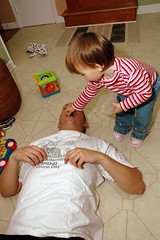 Image by kingary via Flickr
![Reblog this post [with Zemanta]](http://img.zemanta.com/reblog_e.png?x-id=feb2ffa5-3219-47f9-9c02-340184447945)


 Posts
Posts


